
Vexx Audio
Turn down what pokes out.
soothexx works on the spectrum, not on the waveform. It measures every bin, finds the parts standing above their neighbourhood and turns them down, so the tone stays where it was.
Download 0.1.0 for macOS Source on GitHub
Universal, Apple Silicon and Intel, macOS 11 or newer. AU and VST3. Unzip, double click
Install.command, done.
What the engine does
A 2304-point FFT at 48 kHz, power per channel, a prominence curve with a weighted neighbourhood, temporal smoothing and a minimum-phase FIR. Depth is shaped by eight bell modulators, so a reduction can be broad or surgical without touching the rest of the spectrum. Memory is reserved outside the audio callback.
- Host parameters
- 143
- Latency
- 2304 samples
- Formats
- AU and VST3
- Modes
- Soft and hard
Soft, hard and delta
Soft follows how far each bin stands above its neighbourhood: musical material keeps its character, resonances get trimmed instead of removed. Hard replaces the bin with the neighbourhood level, which is what you want on a resonance that has to disappear.
Delta plays what the processor is taking out, on its own. If you can hear more than you expected in delta, you are taking out more than you thought.
The interface
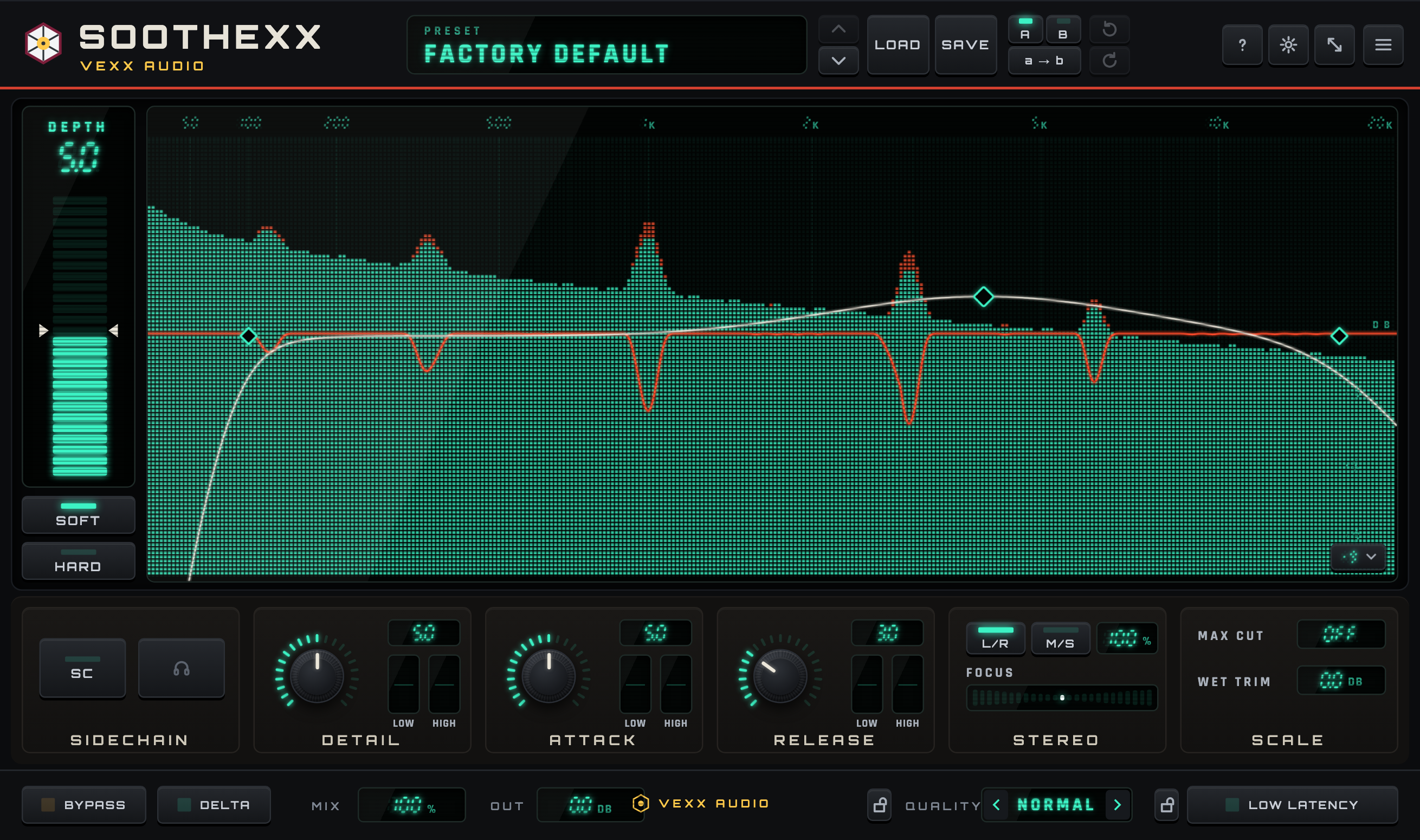
A depth column and an analyser on top, six plates under them, and a strip at the bottom. The analyser draws what the detector sees, not a decoration: with a sidechain engaged it shows the sidechain, the red caps are the reduction in dB on the same scale, and in delta the bars flip to what is being removed.
| Zone | What it holds |
|---|---|
| Header | preset window with load and save, A and B with a copy from one to the other, undo, help, settings, size, menu |
| Screen | depth column and analyser: spectrum, reduction curve, band nodes |
| Plates | SIDECHAIN, DETAIL, ATTACK, RELEASE, STEREO, SCALE, each with its own low and high tilt |
| Strip | BYPASS, DELTA, MIX, OUT, QUALITY |
Depth is the one control you reach for; everything else shapes how it acts. Five presets ship with the plugin, your own are saved, edited and deleted in the preset window, and locks survive a preset load.
Current release
Version 0.1: the spectral engine, the soft and hard modes, delta, the sidechain bus, A/B,
presets, the analyser and the full editor. It ships as AU and VST3, universal for Apple
Silicon and Intel, macOS 11 or newer. The AU answers to aufx vxsh Vexx.
It works. Load it on a mix and push DEPTH.
The bundles are signed ad hoc, not notarized, because notarization needs a paid Apple Developer account. macOS says "unidentified developer" once: right click, Open. Nothing here needs an admin password. If something does not behave as documented, open an issue.
Build it
macOS on Apple Silicon or Intel, a rustup toolchain and the Xcode command line tools. Both architectures are compiled and merged, so the bundle runs natively and under Rosetta.
rustup target add aarch64-apple-darwin x86_64-apple-darwin
cargo test --workspace --release      # 23 tests

scripts/empacar-vst3.sh              # dist/soothexx.vst3
scripts/empacar-au.sh                # dist/soothexx.component

cargo run --release -p vexxsoothe-host --bin verificar-vst3 -- dist/soothexx.vst3
auval -v aufx vxsh Vexx
The AU script clones beamer v0.2.4 at a pinned commit into target/ and builds
the wrapper from beamer's own template; its MIT licence travels inside the bundle.